Scrum is an agile framework developed by Jeff Sutherland and Ken Schwaber that structures work in short cycles (Sprints) based on transparency, inspection, and adaptation. This guide covers everything from basic to advanced: Scrum pillars, values, roles, artifacts, and events, as well as certifications and the job market.
In this complete guide you will discover everything about Scrum from basic to advanced. You will understand the basic concepts, the certifications that exist and how to land a job in the job market.
What is Scrum? 📝
Scrum is an agile framework that aims to provide a structured approach to developing any product. Developed by Jeff Sutherland and Ken Schwaber, Scrum provides a structure that promotes transparency, inspection and continuous adaptation. To better understand what Scrum is and how it works, check out our complete article on What is Scrum.
Now let's use an analogy: Imagine you had to organize a wedding. It could be yours, your sister's or a friend's, it doesn't matter. You felt the responsibility, right? lol. In terms of demand or task, a wedding involves various aspects and needs.
You will probably need a list with everything that needs to be done. In Scrum, we call this list backlog. Since you will be responsible for helping to define the priority of tasks and what needs to be done, you will be the Product Owner.
When you start doing the tasks, you realize you can't handle it alone and call other people to help you, maybe cousin, uncles, cat, parrot, and with that you have a team to help you with the demands. This team, in Scrum, is called the Development Team.
As the days go by, you notice that no one is communicating and no one knows exactly what the other is doing. There are people delivering things from the list that someone else has already done, cousin fighting with aunt and a lot of lack of communication and clarity.
So you have an idea to hold a 15-minute meeting every day at the same time in the morning so everyone can keep track of task progress and so communication noise decreases. This meeting is one of the Scrum events we call Daily Scrum.
As the wedding date approaches, you start to feel insecure about whether you will actually be able to deliver everything. It's your first time doing this! What if when you get there on the wedding day everything is wrong? What if something that was requested, agreed upon is not in accordance? What will you do? Certainly you won't have time to adjust.
Then you have a new idea: instead of delivering everything on the day before the wedding, you decide to make weekly deliveries to try to ensure that what was agreed upon is met and that you have enough time to change something if needed. You then decide that every two weeks you will deliver something! This cycle of constant deliveries in Scrum is called a Sprint.
But how do you know what needs to be delivered every two weeks? How to prioritize these tasks? You then decide to have another meeting between one delivery cycle and another with the development team (cousin, uncle, cat, parrot) so that you can, together with the team, prioritize the demands. This meeting in Scrum is one of the events called Sprint Planning.
In this meeting, you can take several aspects into consideration for prioritizing. One that stands out is: What will bring you the most value until the wedding? Obviously within that delivery cycle! Would it be the bride's dress? Renting the venue? The DJ? Can you slice this delivery?
These prioritized items we can put in the sprint backlog. Which is one of the Scrum artifacts. This way, the team can find themselves better within that cycle (sprint) instead of looking at the product backlog with all items. The team needs to focus on what needs to be done within that delivery cycle (Sprint).
Up to this point, you have already improved communication and clarity with the team through the dailys, you can already know what the priority of things is with the help of Sprint Planning. But now you are getting confused with deliveries if the result is what you expected and you are not having the opportunity to ask for changes. So you propose another meeting so that the team presents at the end of the delivery cycle (sprint) what was completed. Giving the opportunity for everyone to be on the same page about delivered items and have the opportunity to inspect and adapt if necessary.
This meeting is an event in Scrum called Sprint Review. Right at this moment, if someone chose the wrong flowers, or your rented venue that needs changes, suddenly the music playlist is not appropriate in time to change and adapt until the wedding.
Now you feel more secure with deliveries and have much more clarity about what is missing for the wedding. On a daily basis, there is always an uncle who proposes an improvement to these new processes and you don't know how to deal with these suggestions and end up in limbo. They are not demands for the wedding, they are improvement points regarding meetings, communication or work tools. How to deal with this demand? How to make the team feel heard?
You then propose another meeting so that everyone has the opportunity to make these suggestions and can indicate what is being positive and what needs to be improved. This meeting in Scrum is an event called Sprint Retrospective.
We've reached the peak: you have improved your communication, you know how to prioritize, you can monitor deliveries, have constant process improvements every cycle, have weekly task deliveries. Phew, what an evolution! It has everything to be an amazing wedding.
But now there are so many meetings (events); how to ensure these meetings actually happen? How to explain the importance of these meetings and rites to the team? How can the team conduct these rites correctly? Are there metrics we can build together with the team to give visibility to the evolution of the work? And if there is an impediment along the way, who could help? That's where the role of the Scrum Master comes in, who is responsible for ensuring the management and adherence of these processes.
In this analogy, we went through several aspects of Scrum such as Daily, Sprint Planning, Sprint Review, Sprint Retrospective, Backlog, Sprint Backlog and I imagine you understood a bit about how the Scrum Framework works. Below I explain more theoretically about each aspect of it. If you want to better understand how Scrum compares to other methodologies, check out our article on Scrum vs Traditional Methodologies: Which is the best?
The Pillars of Scrum
Scrum is based on three fundamental pillars that shape its philosophy and practices. These pillars are the foundation for building an agile, effective and successful methodology. For a detailed explanation of each pillar, check out our article on What are the pillars of Scrum.
a. Transparency
Transparency is the backbone of Scrum. All relevant information about the project must be visible to all parties involved. This not only promotes a common understanding of the current state of the project, but also establishes a solid foundation for informed decision-making.
b. Inspection
Regular inspection is crucial to ensure quality and compliance. Teams and stakeholders must conduct constant checks to detect unwanted variations and adjust their approaches as necessary. Inspection is not just a practice, but a mindset that permeates all phases of development.
c. Adaptation
Based on continuous inspection, the ability to adapt is a distinctive characteristic of Scrum. Teams must be agile enough to adjust their practices and plans in response to inevitable changes in project conditions or customer requirements.
The Values of Scrum
These are the fundamental principles that guide the mindset and practices within this agile framework. They are:
Commitment: Team members and stakeholders commit to the project's goals and objectives, working together to achieve them.
Courage: Courage is essential to face challenges and seek solutions even in the face of uncertainties, risks and external pressures.
Focus: The team maintains focus on the objectives established for the iteration or sprint, prioritizing tasks that contribute directly to achieving these objectives.
Respect: All team members and stakeholders must be respected and valued for their contributions and skills.
Openness: Transparency and openness are fundamental to promoting effective communication within the team, as well as enabling continuous inspection and adaptation of the process.
These values serve as a guide for the effective application of Scrum, promoting a culture of collaboration, responsibility and continuous improvement. Want to better understand the benefits of applying Scrum? Read our article on Benefits of Scrum.
Roles in Scrum
Scrum defines three main roles, each playing a crucial role in the project's success. To better understand the responsibilities of each role, check out our full article about Roles and Responsibilities in Scrum.
a. Product Owner
This role is held by a person who is responsible for defining the product vision, prioritizing the product backlog, and ensuring that the team is focused on developing the most valuable features for the customer. The Product Owner is the guardian of the product's value.
b. Scrum Master 📝
The Scrum Master is not a project manager. They act as a facilitator, focused on ensuring that the team is properly using Scrum, removing impediments that may arise, and creating an environment that promotes self-organization and team effectiveness. If you are interested in becoming a Scrum Master, check out our guide on How to Become a Scrum Master.
c. Development Team
Composed of cross-functional professionals, the Development Team is responsible for performing the work necessary to transform Product Backlog items into potentially releasable increments. Collaboration and communication are essential for the success of this team.
Scrum Artifacts
Scrum uses a variety of artifacts that serve as tools to facilitate communication and value delivery. Each artifact plays a specific role in the Scrum ecosystem.
a. Product Backlog
A dynamic, prioritized list of all desired features in the product. The Product Owner is responsible for maintaining and regularly updating the Product Backlog, ensuring that the most important features are at the top.
b. Sprint Backlog
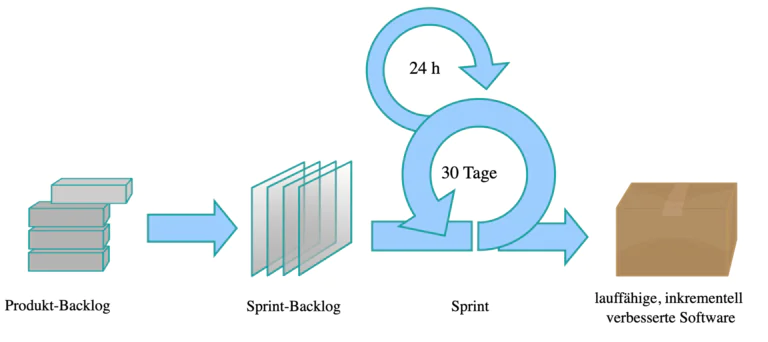
A selection from the Product Backlog, chosen by the team during Sprint Planning, to be delivered during a specific Sprint. This more restricted list allows the team to focus on what is most relevant for the next increment.
c. Increment
The result of the Development Team's work at the end of a Sprint. This increment is potentially releasable, representing a valuable and functional addition to the overall product. The idea is that, at the end of each Sprint, the product is improved and ready to be delivered.
Scrum Events 📝
Scrum is characterized by a series of events or ceremonies that structure the lifecycle of a Sprint. Each event has a specific purpose and contributes to the efficiency and effectiveness of the Development Team. To better understand how these ceremonies work together, read our article about Scrum Ceremonies: The Synchronous Dance.
a. Sprint Planning
This is the starting point for each Sprint. During Sprint Planning, the team, led by the Scrum Master, collaborates to select the work that will be done during the Sprint. The Product Owner provides crucial information about priorities and objectives.
b. Daily Scrum 📝
This is a short daily meeting, usually 15 minutes, where the team shares updates on their progress, discusses challenges, and adjusts plans as needed. The goal is to keep everyone informed and aligned, promoting collaboration and quick problem resolution. For practical tips on how to conduct an effective Daily Scrum, check out our article on Daily Scrum: Benefits and Tips.
c. Sprint Review
At the end of each Sprint, the team holds a review of the increment with stakeholders. This meeting allows the team to demonstrate what was accomplished during the Sprint and receive valuable feedback to adjust the product or the product backlog.
d. Sprint Retrospective
Right after the Sprint Review, the team holds a retrospective. This is an opportunity to reflect on the Sprint, identify what went well, what can be improved, and establish actions to continuously improve the process.
Lifecycle of a Sprint
Scrum organizes product development into cycles called Sprints, typically lasting two to four weeks per sprint.
Where can I take a course? What should I know before buying? 📝
An important point is that a course generally gives you all the necessary knowledge about Scrum and, at the end, you earn a certification from the school where you bought that specific course. In our case, you will receive a certificate proving that you dedicated a workload of X hours to study. If you want to better understand what a Scrum course is and how to choose the best one, read our article about What is a Scrum course and Where to take a Scrum course.
In addition to this knowledge certificate, there are foreign organizations and institutions such as Scrum.Org and Scrum Alliance, founded by the creators of Scrum, which offer certifications that prove an individual's mastery of Scrum.
These certifications are highly valued in the job market. For example, when starting your career, it's important to stand out from others. Therefore, when choosing a course, it's important to check if it also prepares you for this certification!
Here at Learn & Education we offer a complete Scrum course, from basic to advanced, focused on practical application and preparation for certifications. It is part of the G.L.I. Training, which brings together several management and leadership courses (including Scrum). You pay a symbolic monthly fee and have access to all courses and exclusive content. Click here to learn more.
What certifications exist on the market? Which certification should I get? 📝
There are many certifications on the market, the two most famous and widespread certifications are PSM (Professional Scrum Master) and CSM (Certified Scrum Master). When deciding which Scrum certification to pursue, it is crucial to evaluate your own needs, prior Scrum experience, learning style, and career goals. For a complete analysis of all available certifications, check out our article on Scrum Certification: Which ones exist? Which one should I get?
Both the CSM and PSM certifications offer significant benefits, enabling professionals to advance in their agile journeys.
While some may be attracted by the face-to-face learning model and the global recognition of CSM, others may prefer the more exam-focused approach and theoretical understanding of PSM. Ultimately, achieving success in obtaining a Scrum certification depends on commitment to continuous learning, practical application of concepts, and contribution to the success of agile teams.
I personally preferred the PSM I because I had much greater flexibility, the cost was more affordable, and it has very good market acceptance. I don't regret it!
Regardless of your choice, investing in Scrum education and certification demonstrates a commitment to professional excellence and can open doors to exciting and rewarding career opportunities in an agile and ever-evolving world.
How to prepare for the Scrum.Org certification? 📝
Understanding the Preparation
First of all, it is essential to build a solid foundation of knowledge about Scrum. This can be achieved through courses, readings, and practice. Understanding the principles and values of Scrum, as well as the roles, events, and artifacts, is essential for success in the exam. For a complete preparation guide, read our article on How to prepare for the PSM I certification from Scrum.Org.
However, having theoretical knowledge is not enough. The PSM I certification from Scrum.org is known for its challenging questions, which often present complex real-world scenarios. This is where proper preparation comes into play.
The Importance of Practice Tests
Practice tests are a valuable tool in preparing for the PSM I exam. They provide an opportunity to familiarize yourself with the exam format, the type of questions asked, and the approach needed to answer them successfully.
The Scrum.org practice tests, offered by reputable course providers like Learn & Education, are especially useful. They are designed to closely replicate the real exam experience, featuring questions that test not only your theoretical knowledge but also your ability to apply Scrum in practical situations. To learn about the best PSM I simulator, check out our article on The Best PSM I Simulator for the Scrum.Org Exam.
Benefits of Practice Tests:
Familiarity with the Format: Practice tests help you get used to the question format and exam structure, reducing stress and anxiety on test day.
Identifying Gaps: By practicing with tests, you identify areas where you need more study and review, allowing you to focus your learning efforts more effectively.
Strategy Improvement: Practice tests help you develop strategies for handling different types of questions, such as multiple choice, true or false, and case studies.
How to Make the Most of Practice Tests
When practicing with tests, it is important not only to answer the questions but also to review and understand the explanations provided for each answer. This helps reinforce your understanding and correct any misconceptions.
Also, don't limit yourself to a single set of practice tests. Explore different sources and varieties of questions to get more comprehensive preparation.
The PSM I certification from Scrum.org is a significant milestone in the career of any Scrum professional. By preparing properly, with a special focus on practice tests, you will be well equipped to face the exam with confidence and success.
At Learn & Education, we are committed to providing high-quality resources to help you on your certification journey. With our online practice tests, you can prepare effectively and ensure your success on the PSM I exam.
Don't waste time, start your preparation journey today and take the next step towards success in Scrum!
Secure your access to PSM I practice tests: Click Here
Remember, success in the PSM I exam not only validates your Scrum skills but also opens doors to exciting opportunities in the agile job market. We are here to help you every step of the way. Good luck!
What are the benefits of having a PSMI certification? 📝
I'm not the type who believes that a piece of paper is the only way to acquire knowledge. In other words, with the internet, you can acquire knowledge and apply it in your daily life! The big issue is when you enter the job market and face an increasingly competitive market. That's where certification will bring benefits to you! To understand all the benefits in detail, read our full article about What are the benefits of having a PSMI certification.
I didn't believe this until I had the opportunity to be on the other side, hiring people at a large technology company. We receive so many resumes that we need to filter by the "best". A candidate who has a certification conveys to me the security that they have a solid knowledge base. I know this because I have the PSMI certification and I know how much I dedicated myself to obtaining it, and that knowledge remains ingrained.
It doesn't matter if you are a requirements analyst and are torn between going into the product or agility area. Having a PSMI certification is important, as it will differentiate you in the market.
Summarizing the benefits: Skills Validation, Professional Credibility, Career Opportunities, Salary Appreciation, Improved Productivity and Quality, Networking and Community.
Here at Learn & Education we offer a complete Scrum course, from basic to advanced, focused on practical application and certification preparation. It is part of the G.L.I. Program, which brings together several management and leadership courses (including Scrum). You pay a symbolic monthly fee and have access to all courses and exclusive content. Click here to learn more.
We also have the simulator, in case you feel you already have a sufficient knowledge base and just want to practice and feel more confident to get your certification. Click here! To better understand why to use Scrum, also read our article about Why use Scrum and Scrum vs Traditional Methodologies: Which is the best?
Characteristics of the PSMI Certification exam 📝
The PSMI (Professional Scrum Master™ I) exam from Scrum.Org is a comprehensive test that assesses your knowledge and understanding of Scrum principles and practices. To better understand what the exam is like and what to expect, check out our article on What the PSMI certification exam is like and also How to get the PSM I certification from Scrum.Org.
Below are some key characteristics of the exam that you should know:
Number of Questions: The PSMI exam consists of 80 multiple-choice questions, covering a variety of topics related to Scrum.
Exam Time: You will have 60 minutes to complete the exam. It is important to manage your time efficiently to answer all questions within the deadline.
Minimum Score: To pass the PSMI exam, you need to get at least 85% of the questions correct. This means you must correctly answer at least 68 out of the 80 questions.
Format: Multiple Choice, Multiple Answer, True/False
Language: The exam is in English but don't be alarmed! You can right-click on your browser and translate the exam. That's how I did it and passed without mastering the language! Just practice with the simulators beforehand to get used to the questions.
Cost: Currently the investment is $200.00. You can pay and schedule the exam whenever you want! There is no deadline for scheduling.
Validity: It does not expire!
Here are some tips to help you prepare effectively:
1. Study the Scrum Fundamentals: Familiarize yourself with the principles, roles, events, and artifacts of Scrum, as described in the Scrum Guide.
2. Take Practice Tests: Practice with online mock exams to become familiar with the exam format and test your knowledge. Click Here!
3. Take Preparatory Courses: Consider taking a preparatory course, like our PSM60D Method, which offers study materials, practical classes, and support to help you prepare with confidence. Click Here.
4. Review Regularly: Set aside time regularly to review study material and reinforce your understanding of Scrum concepts.
We are here to help you on your journey toward PSMI certification. If you have any questions or need additional support, do not hesitate to contact us.
And the job market for Scrum? Are there vacancies? Is a good salary paid? 📝
There are many possibilities for those who learn the Scrum Framework. When learning Scrum, you will come across the roles of each person within the method. Eventually, you may identify with one of them and specialize, and as a consequence, enter the job market. For a complete analysis of opportunities, salaries, and how to enter the market, read our article on The job market for those who master Scrum.
Upon completing our course, for example, you would already be able to get a job as a Scrum Master to help organizations apply the framework in their daily operations. There is the possibility of working as a consultant or even as a Product Owner.
The interesting thing is that not only the technology market (which was one of the first to apply it) is adopting this framework. Today, we see several areas applying it, such as marketing, HR, legal, finance, among others. If you want to know if it is possible to use Scrum in any project, check out our article on Is it possible to use Scrum in any project?
When searching on Google, you will come across several vacancies in the market. Like everything in life, you will need to prepare to land one of these positions! I won't tell you it's easy, but it's super possible. If I managed to change careers with so many financial difficulties and barriers and today I can provide a better life for myself and my family, you can too. If you are getting started, check out our guide on How to learn Scrum.
The average salary is around R$ 8,000.00 to R$ 17,000.00. That is quite relative, depending on the size of the company and the characteristics of each project! I have seen companies paying much more than average and much less as well. Sometimes, when you are starting out, it's even worth taking on a project that is offering a lower salary to gain experience.
Here at Learn & Education we offer a complete Scrum course, from basic to advanced, focused on practical application and certification preparation. It is part of the G.L.I. Program, which brings together several management and leadership courses (including Scrum). You pay a symbolic monthly fee and have access to all courses and exclusive content. Click here to learn more. If you want to implement Scrum in your company, also check out our article on Best Practices to Implement Scrum in Your Company.