There is no absolute winner: Scrum works best when requirements can change, the project is complex, and you need fast feedback; traditional methodologies work best when requirements are stable, formal documentation is mandatory, and there is little room for change. The choice depends on the project context.
What's the difference? How to choose? Traditional project management (like Waterfall) works like a planned race, where the destination is the successful completion of the project. However, choosing the right methodology can be the difference between a triumphant victory and a slow, complicated journey. In this article, we'll explore the comparison between Scrum, an innovative agile approach, and traditional project management methodologies. So, in this comparison between Scrum vs. Traditional Methodologies, which is the best?

The truth is there's no single answer. Each methodology has its advantages and is more suitable for certain types of projects and contexts. The important thing is to understand the fundamental differences to make the right decision for your reality.
Scrum: the agile and adaptive approach
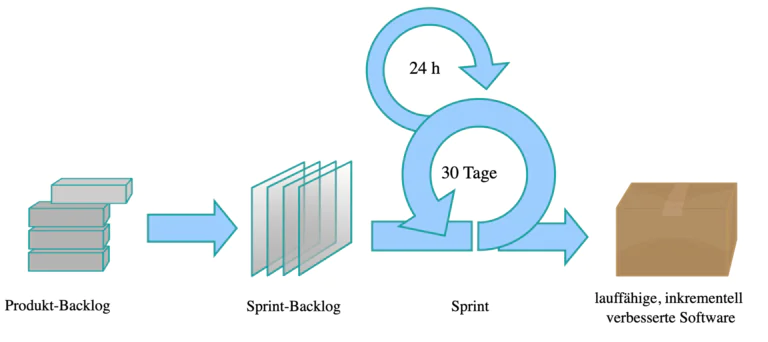
Scrum is known for its adaptive approach, focused on short work cycles called Sprints. It allows teams to quickly adjust to changes and deliver partial results in short periods (usually 2 to 4 weeks). The framework works well when there's uncertainty, when requirements may change, or when you need constant feedback to guide the work.
Main characteristics of Scrum:
- Greater flexibility: living backlog allows adjusting priorities each Sprint without discarding work already done.
- Intensive collaboration: events like Daily Scrum, Planning and Retrospective keep the team aligned and engaged.
- Frequent and visible deliveries: stakeholders see real progress each Sprint, not just status reports.
- Better quality control: constant inspection identifies problems early, when they're still easy to fix.
- High customer satisfaction: quick feedback keeps the product aligned with what the customer really needs.
Traditional methodologies: the sequential and planned approach
Traditional methodologies, such as the Waterfall Model, are characterized by a sequential approach in which each project phase must be completed before advancing to the next. This structure works well when requirements are well defined from the start and there's little likelihood of significant changes during the project.
Main characteristics of traditional methodologies:
- Detailed plans: the entire project is thoroughly planned before execution begins.
- Less flexibility: changes mid-way can be expensive and complex, as they require replanning of already completed phases.
- Greater emphasis on documentation: each phase generates formal documentation that serves as the basis for the next stage.
- Less interaction with the customer: the customer sees results mainly at the end of each phase or at the end of the project.
- Risks of late changes: discovering that something needs to change in final phases can mean significant rework.
Practical comparison: when to use each approach
In the comparison between Scrum and traditional methodologies, the "winner" depends on the type of project, organizational context and specific needs of the team and stakeholders.
Scrum shines in projects:
- Complex and changeable: where there's uncertainty about requirements, technology or market.
- That need adaptability: when changes are expected and even desired during development.
- With constant feedback: when the customer needs to validate hypotheses quickly and adjust direction.
- Product/software: where incremental delivery generates value early on.
- That need timebox: when there's a fixed deadline and you need to deliver maximum possible value.
Traditional methodologies are still valuable in projects:
- With well-defined requirements: when you know exactly what needs to be done from the start.
- That require extensive documentation: in regulatory sectors or when documentation is mandatory (e.g., construction, aerospace).
- Of low complexity: where scope is simple and changes are unlikely.
- With fixed schedule and rigid budget: when there's little margin for adaptation.
- Where execution is well known: repetitive projects with already established processes.
Fundamental differences in practice
Understanding practical differences helps make the right decision:
Planning
Scrum: Incremental planning. You plan only what's necessary for the next Sprint (2-4 weeks). The backlog can evolve based on learning and feedback.
Traditional: Complete planning at the start. The entire project is detailed before execution begins. Changes may require complex replanning.
Delivery
Scrum: Frequent deliveries (each Sprint). Each delivery is a functional increment that can be used.
Traditional: Delivery at the end of the project or each phase. Stakeholders see results mainly in final phases.
Feedback
Scrum: Constant feedback each Sprint Review. Adjustments can be made quickly.
Traditional: Feedback mainly in phase reviews or at the end. Late adjustments are expensive.
Change management
Scrum: Changes are expected and welcome. The backlog can be adjusted at any time.
Traditional: Changes are more difficult. They require a formal change control process and can impact schedule and budget.
How to choose: Scrum or traditional methodology?
Project management is not a single-runner race. Each project is unique, and the choice between Scrum and traditional methodologies should be strategic, based on objective criteria.
Choose Scrum when:
- Requirements are not fully clear or may change.
- You need quick feedback to validate direction.
- The project is complex and has many variables.
- You want to deliver incremental value and start reaping results early.
- The team has the capacity to work collaboratively and self-managed.
Choose traditional methodology when:
- Requirements are well defined and stable.
- Formal documentation is mandatory or critical.
- The project has low complexity and well-known process.
- There's little margin for changes during execution.
- The organizational context requires a more hierarchical and predictable structure.
Hybrid approaches: the best of both worlds
Many organizations discover they don't need to choose "all or nothing". It's possible to use hybrid approaches:
- Traditional planning with agile execution: Plan the macro with Waterfall and execute specific phases with Scrum.
- Scrum with structured documentation: Use Scrum while maintaining formal documentation at specific points of the project.
- Traditional methodology with review cycles: Maintain sequential structure, but include reviews and adjustments between phases.
The important thing is to be pragmatic: choose the approach (or combination) that works best for your specific context.
Conclusion: there's no absolute winner
The truth is there's no absolutely "better" methodology. Scrum is not superior to traditional methodologies in all contexts, just as traditional methodologies are not superior to Scrum in all situations.
What matters is understanding the characteristics of each approach, evaluating your specific context (project type, team, organization, stakeholders) and choosing the methodology that best fits your reality.
Scrum is excellent for projects that need adaptability and rapid value delivery. Traditional methodologies are valuable for projects with stable requirements and that require formal documentation. The best choice depends on the "project terrain" and "track conditions".
Regardless of the chosen methodology, the important thing is to have a trained and committed team to successfully achieve project objectives. The methodology is a tool — success comes from applying it well, in the right context, with engaged people.
Here at Learn & Education we offer a complete Scrum course, from basic to advanced, focused on practical application and certification preparation. It's part of G.L.I. Training, which brings together several management and leadership courses (including Scrum). You pay a symbolic amount per month and have access to all courses and exclusive content. Click here to learn more.