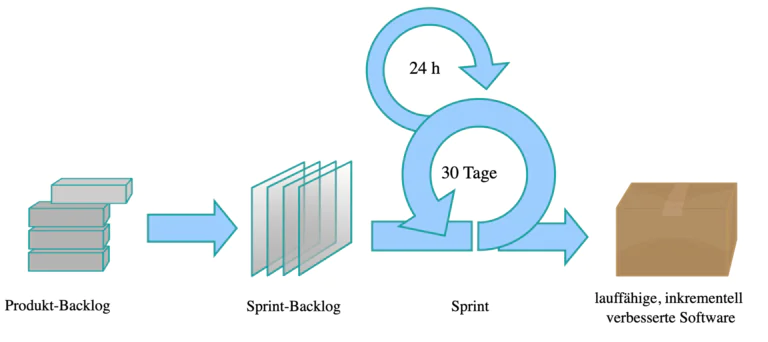
Scrum ceremonies are five events that structure the work of each Sprint: Sprint Planning, Daily Scrum, Sprint Review, Sprint Retrospective, and Backlog Refinement (a common practice, although not official in the Scrum Guide). Together, they ensure transparency, inspection, and adaptation, like a synchronized choreography toward project success.
Imagine a classical ballet. Dancers execute graceful and coordinated movements, all synchronized to the rhythm of the music. In the world of Scrum, ceremonies are like these carefully orchestrated choreographies, designed to keep the team aligned and ensure project success. In this article, you'll discover how Scrum ceremonies — Sprints, meetings, and artifacts — combine to create a synchronized dance toward the project's objective.

What are Scrum ceremonies?
Scrum ceremonies are formal events that structure the team's work within each Sprint. They ensure transparency, inspection, and adaptation — the three pillars of Scrum. Just as a ballet requires rehearsals, performances, and continuous adjustments, Scrum needs these ceremonies to function effectively and deliver consistent value.
The Sprint: The Main Act of the Performance
The Sprint is the main act of Scrum's performance, equivalent to a complete act in a show. It is a fixed time period (usually 1 to 4 weeks, with 2 weeks being the most common) during which the team works to deliver a ready and usable product increment.
Important Sprint characteristics:
- Fixed duration: Once defined, the duration does not change during the Sprint
- Clear objective: Each Sprint has a specific goal (Sprint Goal)
- Ready increment: At the end, there must be a product increment that can be delivered
- No interruptions: During the Sprint, the goal or selected tasks are not changed
The Sprint begins with Sprint Planning, where the team selects backlog tasks to be executed, and ends with Sprint Review and Sprint Retrospective, where results are presented and the team reflects on how to improve.
The Meetings (Ceremonies) of Scrum
Meetings in Scrum are like rehearsals in a show — strategic moments where details are constantly adjusted to enhance performance. There are five main events in Scrum:
1. Sprint Planning
Similar to a choreography meeting, Sprint Planning is where the team chooses the tasks it will execute during the Sprint. It is divided into two parts:
- What to do: The Product Owner presents prioritized backlog items and the team selects what it can deliver in the Sprint
- How to do it: The development team plans how it will carry out the work and creates the necessary tasks
The Product Owner acts as the choreographer, explaining what needs to be done and why, while the team decides how it will execute tasks autonomously. The result is the Sprint Backlog — the list of tasks the team commits to deliver.
2. Daily Scrum
This is the daily "warm-up" meeting, where the team gathers for 15 minutes (maximum) to share updates, obstacles, and plans for the day. It's like dancers reviewing their movements before taking the stage.
Each team member answers three questions:
- What did I do yesterday that helped the team achieve the Sprint goal?
- What will I do today to help the team achieve the Sprint goal?
- Is there any impediment blocking me?
The focus is not on reporting status to the Scrum Master or Product Owner, but rather on synchronizing work and identifying blockers that need to be resolved.
3. Sprint Review
This is the grand presentation at the end of the act, where the team shows the results of work completed during the Sprint. It's a moment of demonstration, feedback, and collaboration with stakeholders.
During the Sprint Review:
- The team demonstrates the product increment developed
- Stakeholders provide feedback and suggestions
- The Product Backlog may be adjusted based on feedback
- What was learned and what can be improved is discussed
It's the moment to celebrate achievements and validate whether the product is heading in the right direction, similar to a performance before an audience in a show.
4. Sprint Retrospective
The Retrospective takes place after the Sprint Review and is a moment of reflection on the process. The team discusses:
- What worked well in the Sprint?
- What could be improved?
- What actions will we take in the next Sprint to improve?
It's like a post-rehearsal conversation where dancers discuss how to enhance performance. The Retrospective is fundamental for continuous improvement — one of Scrum's core values.
5. Backlog Refinement
Although not an official ceremony in the Scrum Guide, Backlog Refinement (or Grooming) is a common and very useful practice. It's a moment where the team reviews and prepares Product Backlog items for future Sprints, ensuring they are well-defined, estimated, and ready to be selected.
The Artifacts: The Costumes and Set
Scrum artifacts are like the costumes and set that bring the show to life. They make work visible and transparent, allowing everyone to understand what's happening.
Product Backlog
Similar to costumes that need to be chosen and prepared, the Product Backlog is the ordered list of all features, improvements, and fixes the product needs. It is maintained and prioritized by the Product Owner, who decides the order based on the value each item brings to the business.
Product Backlog characteristics:
- Dynamic: Constantly evolves as the product and market change
- Prioritized: Higher-value items are at the top
- Detailed: Items close to being developed have more details
Sprint Backlog
The Sprint Backlog is the set of Product Backlog items selected for the current Sprint, plus the plan to deliver them. It's like the specific script for an act — it contains only what will be done in that period.
Product Increment
The Increment is like the set that changes and evolves throughout the show. It's the representation of work completed during the Sprint — a product increment ready to be delivered. Each Sprint adds a new element to the set, building the product incrementally and iteratively.
An Increment must be:
- Ready: Meeting the team's Definition of Done
- Usable: Can be delivered and used by users
- Integrated: Works together with previous increments
How ceremonies connect
Scrum ceremonies are not isolated events — they form a continuous cycle that repeats every Sprint:
- Sprint Planning: Defines what will be done
- Daily Scrum: Keeps the team synchronized daily
- Sprint Work: Increment development
- Sprint Review: Presents results and receives feedback
- Sprint Retrospective: Reflects and plans improvements
- Back to the beginning: New Sprint Planning with applied learnings
This cyclical repetition allows the team to learn, adapt, and continuously improve, just as a group of dancers enhances their performance with each presentation.
Benefits of well-executed ceremonies
When ceremonies are well-facilitated and respected, the team experiences:
- Transparency: Everyone knows what's happening and why
- Alignment: The team works toward the same objectives
- Rapid adaptation: Problems are identified and resolved quickly
- Continuous improvement: With each Sprint, the team becomes more effective
- Consistent deliveries: Value is delivered predictably and regularly
Common mistakes and how to avoid them
Some frequent mistakes can compromise ceremony effectiveness:
- Skipping ceremonies: "We don't have time" — ceremonies save time by preventing problems
- Ceremonies that are too long: Following timeboxes helps maintain focus
- Lack of preparation: Product Owner and team must prepare for ceremonies
- Ceremonies without purpose: Each ceremony must be useful and involve all participants
- Lack of action: Identifying problems in the Retrospective without acting is useless
Conclusion: The magic of Scrum's dance
Scrum is like a synchronized dance, where ceremonies — Sprints, meetings, and artifacts — combine to create a spectacular performance. Each part plays a fundamental role in ensuring project success, just as each act, rehearsal, and visual element is essential for a memorable presentation.
By understanding and mastering these ceremonies, your team will be ready to execute a synchronized dance toward project success. Remember: ceremonies are not just rituals — they are powerful tools for creating transparency, alignment, and continuous improvement.
Here at Learn & Education we offer a complete Scrum course, from basic to advanced, focused on practical application and certification preparation. It's part of the G.L.I. Training, which brings together various management and leadership courses (including Scrum). You pay a symbolic monthly fee and have access to all courses and exclusive content. Click here to learn more.