Scrum is an agile framework for organizing complex work in short cycles. Discover what it is, how it works and why companies adopt this methodology to deliver value with more flexibility and quality.
If you've heard of Scrum but still don't understand what it really is, you're not alone. Many people associate this word with complicated methodologies, endless meetings or something that only works for technology companies. The truth is that Scrum is simpler — and more powerful — than it seems at first glance.
Scrum is an agile framework for organizing complex work in short cycles, with constant transparency, inspection and adaptation. It's not a manual full of rigid steps; it's a minimal set of rules designed so teams can deliver value fast, learn from real feedback and adjust course whenever necessary. If you need to deal with uncertainty, frequent changes and demands that evolve as work progresses, this methodology may be the answer.
What is Scrum, in practice
Imagine that you need to deliver a product or project, but requirements change along the way. Instead of following a fixed plan that may become obsolete, Scrum proposes working in short cycles (Sprints), delivering something functional at the end of each cycle and adjusting the next cycle based on what was learned. It's like navigating unknown waters: you can't chart a definitive route at the start, but you can constantly adjust based on what you're discovering.
The differential of this approach lies in the combination of three elements: minimal structure (only the essential), constant feedback (you quickly know if you're on the right track) and frequent adaptation (you can change course without wasting all the work done). This makes Scrum especially useful when you deal with complexity, not just complication.
The three pillars of Scrum
The entire framework is supported by three fundamental pillars. Understanding each one is essential to truly apply Scrum, not just follow the letter of the rules.
Transparency
Transparency means that everyone involved clearly sees what is being done, what remains to be done and what the impediments are. There are no hidden information or "black boxes" in the process. The Product Backlog is visible to everyone, Sprint progress is clear during Dailies, and results are presented openly in the Review.
Why does this matter? When everyone sees the same information, decisions become faster and based on real data, not assumptions. Stakeholders know exactly what to expect, and the team has clarity about priorities.
Inspection
Inspection is the practice of reviewing progress frequently to identify deviations, problems or improvement opportunities. This happens at Scrum events — Daily Scrum to check daily progress, Sprint Review to evaluate what was delivered, and Sprint Retrospective to look at the process itself.
The key here is frequency: you don't wait months to discover that something isn't working. Each Sprint offers an opportunity to inspect and adjust. It's like doing regular health check-ups — problems are detected early, when there's still time to correct them.
Adaptation
Adaptation is the ability to change the plan when inspection reveals that something needs to be adjusted. If during the Sprint you discover that a requirement no longer makes sense, you can adapt. If the Retrospective shows that a process is hindering, you can change it. The framework gives this flexibility without creating chaos.
This is the difference between Scrum and traditional methodologies: you're not stuck with a plan made months ago. When reality changes — and it always changes —, you adapt the work, you don't pretend nothing happened.
How the Scrum flow happens in practice
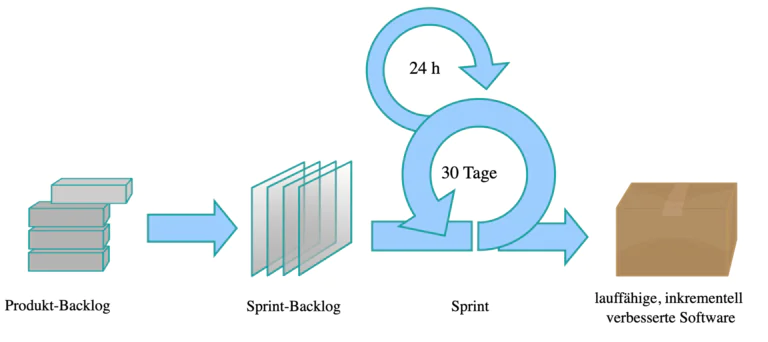
Scrum works in cycles called Sprints. Each Sprint has a fixed duration (usually 1 to 4 weeks) and follows a predictable pattern of events. This constant rhythm helps the team create a healthy sense of urgency and deliver value regularly.
Sprint Planning
At the start of each Sprint, the team meets to plan what will be done. The Product Owner presents the most prioritized items from the backlog, and the team chooses what it can deliver in the Sprint period. The goal is not to make a huge list of tasks, but to select what really matters and define a clear goal for the Sprint.
Daily Scrum
Daily, the team meets for 15 minutes to align progress and identify impediments. It's not a status report meeting for the boss — it's a quick conversation among the team to ensure everyone is synchronized and that blockers are resolved quickly. The classic structure is three questions: what did I do yesterday, what will I do today and is there any impediment?
Sprint Review
At the end of the Sprint, the team presents to stakeholders what was delivered. It's not a formal PowerPoint presentation — it's a real demonstration of the product increment. The goal is to gather direct feedback and validate if the work is on the right track. This feedback feeds the next planning cycle.
Sprint Retrospective
Right after the Review, the team looks at the process itself and identifies improvements. The focus is not to blame people, but to understand what worked well, what can improve and what needs to change. These improvements become concrete actions for the next Sprint, creating a cycle of continuous process evolution.
Essential roles in Scrum
The framework defines three distinct roles, each with specific responsibilities. Understanding these roles is fundamental for Scrum to work well.
Scrum Master
The Scrum Master is the facilitator of the process. Their main function is to ensure the framework is applied correctly, remove impediments that hinder the team and protect the group's focus. They are not a traditional project manager — they don't manage people, but rather the Scrum process.
A good Scrum Master helps the team understand the principles behind the rules, facilitates events so they are productive, and works to remove blockers that prevent progress. They also help the organization understand and adopt the agile mindset.
Product Owner
The Product Owner is responsible for maximizing the value delivered by the team. They maintain the Product Backlog, prioritize items based on business value, and ensure the team always works on what matters most. They are the bridge between stakeholders and the development team.
The Product Owner's central responsibility is to make decisions about what will be done and in what order. They need to understand business needs, talk to stakeholders, and translate all of this into clear and prioritized backlog items.
Development Team
The Development Team is multidisciplinary and self-manageable. These people are responsible for transforming backlog items into ready-to-use product increments. The team decides how to do the work, estimates the necessary effort and organizes itself to deliver value.
The key word here is "multidisciplinary": the team needs to have all the skills necessary to deliver the complete increment, without depending on outside people. This allows autonomy and agility in deliveries.
Why companies adopt Scrum
Scrum is not a passing fad — companies adopt it because results appear. But what are the real benefits that justify this choice?
Flexibility with responsibility
One of the biggest advantages is the ability to change course when necessary, but based on real data from each delivery. You don't change because you "thought it better", but because the Review showed that the product needs adjustments or because market conditions changed. This intelligent flexibility reduces waste and increases the chance of hitting what the market really needs.
Frequent value delivery
Instead of working months on something that will only be seen at the end, stakeholders see real progress every Sprint. This allows early feedback, quick adjustments and constant hypothesis validation. If you're building something that doesn't make sense, you discover it in weeks, not months.
Higher quality
Constant inspection and frequent adaptation mean problems are identified and corrected quickly. There's no time to "leave for later" or "fix in the next version". Each Sprint needs to deliver something that works, which naturally raises the quality of work.
Greater team engagement
Teams that work with Scrum are usually more engaged because they participate in decisions and understand priorities. They are not just "task executors" — they are active part of the building process. This increases motivation and sense of responsibility.
Where Scrum works well (and where it doesn't)
Scrum is not a universal solution. It shines in certain contexts and may not make sense in others. Understanding this avoids frustration and helps choose the right approach for each situation.
Where Scrum works well
The methodology is especially effective in creative and knowledge work, where there is uncertainty and need for continuous learning. Typical contexts include product development, software, digital marketing, education projects, operations that need to adapt quickly, and any situation where requirements change or are discovered during work.
If you need to deal with complexity (many variables, non-linear relationships, unpredictability), Scrum offers the minimal structure necessary to navigate this terrain. The key is that the framework was made to work with uncertainty, not to eliminate it.
Where Scrum may not be ideal
Fully rigid projects, with well-defined requirements from the start and no room for adaptation, may not benefit as much from Scrum. Repetitive and highly standardized work may also be more efficient with other approaches.
This doesn't mean you need to choose "all or nothing". Many organizations use hybrid approaches, applying Scrum where it makes sense and other methods where they are more suitable. The important thing is to understand the context and choose the right tool.
Conclusion: Scrum as mindset, not just process
Scrum is much more than a set of rules and events. It's a mindset based on empiricism, transparency and continuous improvement. When truly applied, it transforms not only how work is organized, but also the organization's culture.
Scrum's success doesn't come from following rules to the letter, but from understanding the principles behind them. Transparency, inspection and adaptation are not just nice concepts — they are practices that, when incorporated into daily life, generate tangible results.
If you want to truly apply Scrum in your reality, start with the fundamentals: understand the three pillars, practice the events, experience the roles. Over time, you'll realize that the framework is simple to understand, but challenging to master — and it's precisely this combination that makes learning valuable.
Here at Learn & Education we offer a complete Scrum course, from basic to advanced, focused on practical application and certification preparation. It's part of G.L.I. Training, which brings together several management and leadership courses (including Scrum). You pay a symbolic amount per month and have access to all courses and exclusive content. Click here to learn more.