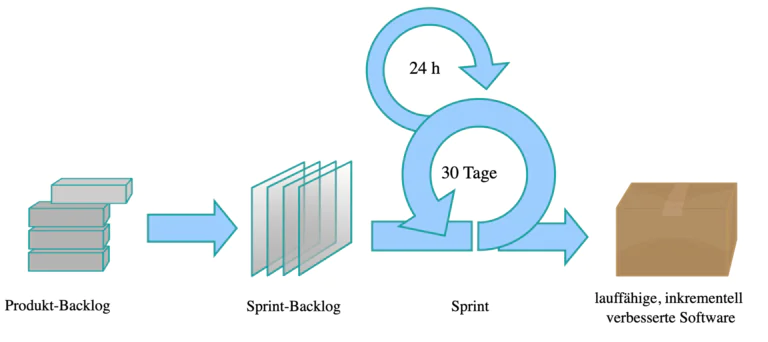
Companies use Scrum for four main reasons: flexibility to handle priority changes without losing control, transparency about what is in progress, focus on what generates the most value, and a sustainable pace of Sprints with a fixed duration. In practice, this turns into more productivity, quality, and predictability.

Why do so many companies adopt Scrum? Scrum is one of the most used agile frameworks in the world for organizing complex work, especially when there are many demands, frequent changes, and a need for continuous learning. It helps teams and companies move from a stuck "big project" logic to a model of smaller, frequent deliveries with much more visibility. When properly applied, Scrum is not just a set of meetings: it changes how the team sees priorities, collaborates, and makes decisions. Main reasons to use Scrum
Scrum is one of the most widely used agile frameworks in the world for organizing complex work, especially when there are many demands, frequent changes, and a need for continuous learning. It helps teams and companies move from a logic of a stuck "big project" to a model of smaller, frequent deliveries with much more visibility.
When applied well, Scrum is not just a set of meetings: it changes how the team sees priority, collaborates and makes decisions.
Main reasons to use Scrum
Some practical reasons to adopt Scrum in your company or team:
- Flexibility with accountability: the framework was designed to handle changes in requirements and priorities over time, without losing control of what is being done.
- Transparency: everyone can see what is in progress, what has been completed, and what is blocked, through boards, backlogs and well-defined rituals. To better understand the pillars of Scrum, including transparency, check out our article.
- Focus on value: instead of starting with what is “easier” or “cooler”, the team starts prioritizing what generates the most impact for the customer or the business.
- Sustainable pace: fixed-length Sprints help build a healthy cycle of planning, execution, review and improvement, cutting down last-minute scrambles.
Benefits in the team's daily routine
In practice, the benefits appear in several dimensions:
- Productivity: the team spends less energy switching focus all the time and more energy finishing what was agreed for the Sprint.
- Quality: constant inspection, frequent reviews and retrospectives help catch problems early and adjust the way of working.
- Engagement: people understand the purpose behind the work better, have more say in decisions and can see the impact of what they do.
- Predictability: over time the team understands its own capacity better and can make more realistic promises.
Scrum from the client and business perspective
For the customer (internal or external), Scrum creates the feeling that the product or service is always moving forward. Instead of waiting months to see something finished, they follow frequent increments, give feedback and adjust course together with the team. To understand the benefits of Scrum better, read our full article.
For the business, this means:
- reducing the risk of investing heavily in something that doesn't deliver the expected result,
- being able to ship smaller, simpler versions sooner,
- learning from real data and not just from assumptions.
When it makes sense to consider Scrum
Scrum usually makes a lot of sense when:
- the work involves uncertainty, discovery or innovation,
- there is constant interaction with customers or partner areas,
- scope and priorities can be adapted over time,
- you want to build a culture of continuous improvement and collaboration.
If your context is extremely rigid, with scope and dates completely locked and almost no room to adapt, you may need to combine Scrum with other practices or start with smaller steps of agile management. To find out whether Scrum can be used on any project, read our article.
How to take the next step
If you want to move beyond theory and start really applying Scrum, a good path is to go deeper in a course that connects the framework to real market situations. At Learn & Education we have a complete Scrum course from basic to advanced, focused on practical application and built for those who want to grow in their career. If you want to know where to take a Scrum course or how to learn Scrum, check out our articles.
This course is part of the G.L.I. Training, a program in Management, Leadership and Indicators that also includes the Scrum module. You pay a symbolic amount per month and get access to all courses and exclusive content. Click here to see the program.