
Annual planning follows two steps: first the Satisfaction Map, which rates nine areas of life from 0 to 10 (health, relationships, and work, among others) to diagnose where you are; then the Achievements Project, which turns this diagnosis into concrete goals. The method is based on three pillars: progress, balance, and freedom.
Discover how to set clear and achievable goals for 2025 and make your annual planning. A new year is about to begin, and everyone starts with promises: "Next year will be better!", "This time I'm going to start such and such!". And look, I'm no different either.
But wait! In this article I'm going to teach you how to do annual planning. And you'll be able to plan your new year in a structured and effective way.
Prefer to watch instead of read? Watch the full video below:
The three pillars of annual planning
When we talk about making next year the best, it's important to have a parameter to define what that means. For me, it comes down to three very important pillars:
- Progress: Am I moving forward toward the things that really matter to me?
- Balance: Am I managing to keep my life balanced between personal and work?
- Freedom: How close am I getting to my financial freedom with my personal projects?
Based on these three pillars, you can create a very simple method that you can apply at any time of the year. This will help you measure how much you're evolving in terms of progress, balance and freedom. In addition to giving you clarity to define your New Year's goals.
The Satisfaction Map: first step
To start, I want to propose a quick and practical reflection exercise that I call the "Satisfaction Map". The idea here is to evaluate different areas of your life and identify how you feel about each one of them.
These methods are super easy to apply and can be used whenever you want, helping you organize yourself and ensuring that next year is really the best, full of meaning, balance and, of course, fun.
So, let's go: the first step is the Satisfaction Map, where we divide life into several areas and evaluate how we are in each one of them.
You can do this exercise wherever you want: on a piece of paper, on your phone or even on a tablet. I, particularly, think paper is always a good option, because it helps avoid distractions.
Remembering that this is just an initial suggestion. You can adapt and customize the categories according to what makes more sense for you.
So, did you draw it? You can pause and do it with me.
Now that we've categorized the circle, let's segment it, dividing each part into smaller items. For example:
- In the Health category, you can include: Nutrition, Body and Mind.
- In Relationships, we can put: Dating, Family and Friends.
- In Work, we can think about: Personal Projects, Money and Growth.
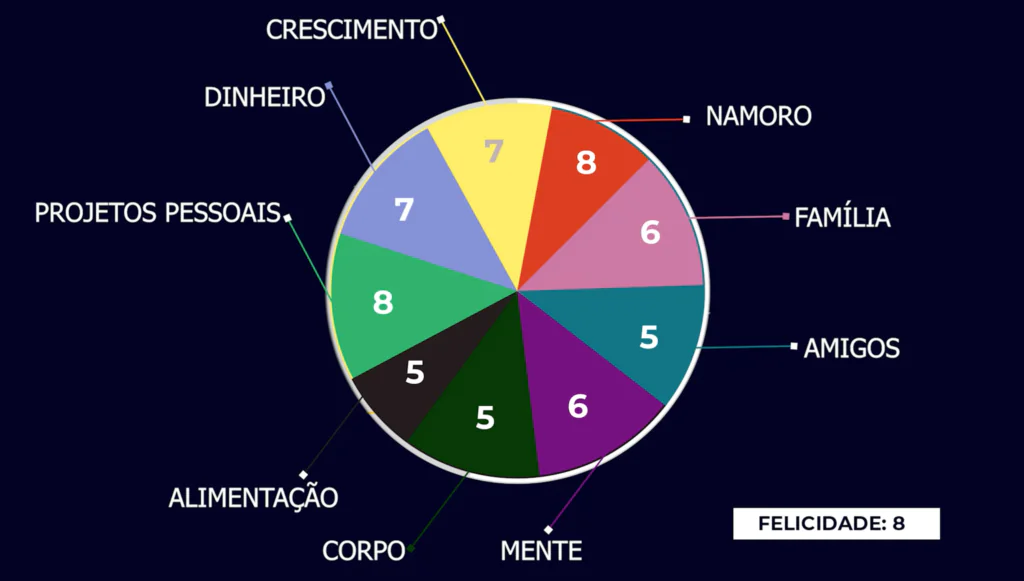
If personal projects don't make sense to you, that's fine! You can replace it with Career, Freelancer or anything else that fits better into your reality.
I don't know if you noticed, but we managed to divide life into nine components. The next step now is to evaluate each one of them. After all, how are you going to achieve your goals without a clear diagnosis? For that, let's use a scale from 0 to 10: how satisfied are you with this specific area of your life?
Remember: the focus here is the current state of each area, regardless of what you've done or haven't done. It's about how you feel now.
I guarantee that, in the end, you'll have a lot of clarity and some good reflection points.
Here's how my example map turned out. If you want, you can even color the areas according to the numbers you assigned — this can bring more clarity, especially for those who are more visual or like something more creative. But I'm on the simple team, so I went straight to the point. Do it the way that's most comfortable for you.
And, before continuing, I want to challenge you to add an extra category to your map: Happiness. Put it as a separate area, at the bottom, and evaluate: how happy are you with the experiences you're living in the present? For me it was a 7 out of 10.
Now you already have a map with a diagnosis that will help you make next year the best year of your life. Following the logic of the exercise, if we manage to reach 10 in each area, that means we're achieving our goals and prioritizing what really matters to us. In addition, we would be balancing all areas of our life.
If you stop to think, the map we drew covers practically all important aspects of our existence. And, with the addition of the Happiness category, it reminds us to enjoy the journey while we build this balance. Just thinking about it, doesn't it give you a good feeling?
With the base of our map ready, we can draw up a plan to improve each category. This includes setting goals and creating a plan to raise the numbers you scored.
A big part of making next year the best year of your life is exactly that: moving towards these goals and building the progress you deserve.
Now is a good time for you to highlight some areas that you would like to take more care of or that need more attention.
In the Health category, for example, I rated Mind poorly, but I'm not as worried about it as I am about my body and nutrition. In my case, I spend a lot of time sitting, and lack of exercise and poor nutrition have been bringing me complications.
In the Work area, the scores for Money and Personal Projects were better, but I think I can improve in Growth, because I would like to be closer to what I projected for myself.
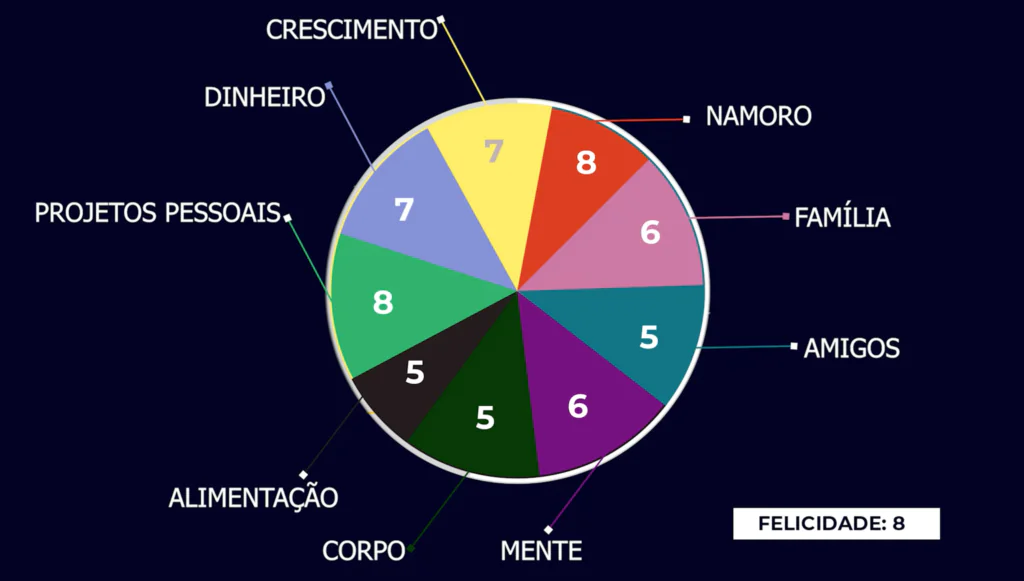
Are you understanding the dynamics? The more you practice the Satisfaction Map method, the more clarity you'll have about the points you need to improve. The best part is that you can adjust it at any time of the year. Whenever you feel that things aren't going as you'd like, you can come back, reassess and assign new scores. It's something quick, takes seconds and helps a lot.
And don't feel bad about the diagnosis or the current portrait of your life. Now you have more clarity and can take measures to improve each of the areas.
Oh, and if you're wondering why I gave such a high score to Personal Projects, it's because I'm very happy with what I've been developing and the partnerships I'm closing. For example, if you're looking to leverage your career and develop skills in management, leadership and productivity, you might be interested in Learn & Education, where I'm a teacher and one of the partners.
It's an online platform that offers the G.L.I. Training, with courses on management, leadership and productivity, that will transform your career. The best part? You pay a symbolic amount and have access to all content. It's like paying the price of a hamburger for something that can change your life.
The Achievement Project: defining your goals
Now we can move on to the next step. We've already done the diagnosis and highlighted the areas that need more attention, so it's time to work on your goals.
There are several ways to define goals, and you can use whichever you prefer. In my case, I've been doing this for years, because it's part of my job.
And look, it's no wonder that many studies show that people who set goals have better performance, more productivity and feel more fulfilled compared to those who don't.
Writing goals puts you at a much higher level than those who don't organize or prioritize ideas.
Thinking that maybe you're not yet so familiar with goal setting, I decided to adapt a simple method and call it "Achievement Project". The idea here is that you can take the concept and apply it in practice in a light and uncomplicated way. This will help you with your goal planning. In this step you will discover how to create an annual action plan to achieve goals.
The dynamic is very simple: ask yourself "What would I like to be celebrating 12 months from now or at the end of next year?"
Imagine yourself with your family or friends, celebrating the advances you've made in different areas of your life.
Remember the areas we highlighted in the satisfaction map? You can start with those that need more attention. And if you're doing this exercise at the beginning of the year, I recommend applying it to all areas. It might be a bit more work, but once done, you'll only need to adjust over time.
So, ask yourself: "12 months from now, in each of these areas, what would I like to be celebrating?"
Let's go to a practical example: in my example satisfaction map, the Body category had a low score. So, I can imagine myself with my friends, sitting in Ibirapuera Park, celebrating how I managed to improve my body health in the last 12 months.
Here are some goals I would like to be celebrating:
- Having increased my muscle mass
- Having lost weight and reached my ideal weight
- Going to the gym frequently, at least every other day
- Practicing some kind of sport at least once a week
The tip here is to try to choose just one of these goals. Choosing many fronts can be difficult to achieve and ends up demotivating you along the way. So, if you had to choose just one, which would it be?
In my case, reaching my ideal weight would bring the bonus of improving other aspects of my health, such as getting out of pre-diabetes, having more disposition in everyday life, among other benefits.
Now just repeat this process in the different categories you mapped.
A very important point: have your goals recorded somewhere that is easy to access. It can be a Google Docs, a notebook or any other practical place, where you can track the progress of these goals. It's essential to have a space where you can break these goals down into smaller, more tangible objectives, making execution easier.
To help you in this mission, I'll leave below the possibility for you to download a spreadsheet. If you don't know where to start, this spreadsheet is a lifesaver. It will help you transform all of this into something simple and practical.
📥 Download the Achievement Spreadsheet: 👉 https://bit.ly/planilha-conquistas
Most people fail at this point: they define goals only in their head, but don't record them anywhere. The result? They end up getting lost along the way. That's why you need to review your goals regularly, set aside a moment to reflect and ask yourself: "Am I on the right track?"
For a long time, I used online spreadsheets for this and even saved the link in my browser's favorites. This helped me maintain focus and clarity about what I needed to do.
Another important point when defining your goals is to bring meaning to them. Adding the why behind each goal helps bring clarity, motivation and, especially, meaning to the sacrifices that may arise along the way. If the goal doesn't have a clear purpose, it's very easy to get discouraged and frustrated.
For example:
- I want to lose weight and reach my ideal weight to have more health, disposition and avoid diseases that obesity can cause
Do you see the difference? When you bring the "why", the goal gains more weight and this will motivate you much more to achieve the result.
My suggestion is that you start with weekly reviews. Over time, as you gain more control and clarity, you can increase the interval between reviews — biweekly or even monthly, depending on your need.
The spreadsheet will help you a lot in this regard.
Now that you have everything you need — the map, the goals and the tools — it's up to you to take the first step. Remember: next year will only be the best year of your life if you act to make it happen.
There's no magic, but there is a method. And with the right tools, next year can be the beginning of the best phase of your life.
Start simple, but start. Reflect, set your goals and review frequently. The most important thing is not to wait for the "perfect Monday" or the "ideal moment". The moment is now.
If this text made sense to you, comment which areas of your life you will prioritize first. And of course, share this text with someone who also wants to transform next year! I'm sure you now know how to plan a new year.